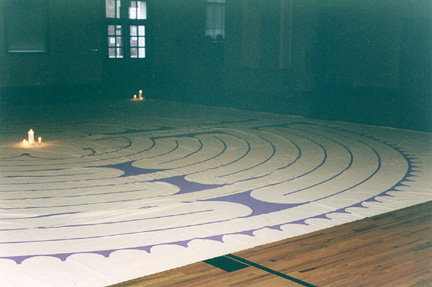
Five-Minute Labyrinth
Text and drawings by Seed (Calla Unsworth)
RQ team takes 45 minutes to build 5-minute labyrinth
How to draw a labyrinth by yourself
Here's a fun, quick way to make a Cretan labyrinth with a group. Try scuffing it into sand at the beach, using chalk on pavement, cornmeal on a forest floor, or straw on dirt. These instructions are for a group of seven people, but are easily adapted for a smaller group. Making it is like a dance!
A. Make the center as large as you want. It can be large enough to hold the whole group, if you have enough room. Make the opening to the center about two paths wide.
B. Seven people stand in a line below the opening to the center. How far apart you stand determines how wide the paths will be. Make sure you have enough surrounding area for all seven people to walk completely around the center (see step 6).
C. Draw an anchor line straight down from the center, reaching all the way to the seventh person.
D. Everyone stand back from the anchor line, far enough back for two paths to fit between you and the anchor line.
E. Draw lines as follows:
- Person 2 loops around to the center and back.
- 3 goes to the anchor line and back.
- 4 loops around to kiss 6 and back.
- 7 goes to the anchor line and back.
F. Turn around. Everyone walk in concentric circles, making the path lines. Remember to stop two path-widths away from the anchor line on the other side as well - see drawing at left.
G. Move as follows:
- Person 1 loops around to kiss 3.
- 4 goes to the anchor line.
- 5 loops around to kiss 7.
- You're done!
Return to top of page
RQ Takes 45 Minutes to Build 5-Minute Labyrinth
As a special service to our readers, the RQ cell recently took time out from proofreading to test the Five-Minute Labyrinth (see photos in opposite story).
As our magical site, we chose a small, little-trafficked intersection near our production headquarters in central San Francisco. We brought twenty pounds of corn meal, but it wasn't nearly enough, and we had to gather dirt from along the fence to finish the project. We recommend fifty pounds of corn meal.
It took twenty minutes to build the labyrinth, and twenty more to consense on our interpretation of the instructions. Add five minutes to decide what order to stand in, and you've got 45 minutes.
Return to top of page
Drawing a Labyrinth by Yourself
from RQ#79, Summer 2000
The 7-circuit labyrinth is drawn as shown. To draw an 11-circuit labyrinth, add an "L" in each corner and follow the same plan as for 7-cirvuit -- see diagram, lower right.
|
Walking Our Spells
Labyrinths of Healing
by Rowan Phillips
Photos show RQ volunteers building the five-minute labyrinth - see story at left
During a visit to Chalice Well in Glastonbury, England in the mid 1990s, I spent hours walking the rugged sides of the tor and meditating at the well. Like the planets in my own chart, this was earth and water, and the places where they converged to create a liminal site of pilgrimage. When it was time to leave, I wondered how I could re-create this sense of pilgrimage and liminal time for myself and for others. The labyrinth has provided one powerful answer.
Anyone who has walked a labyrinth may know that it is a wonderful, kinesthetic way of calming the mind, dropping unwanted cares, and working out problems. One way to use this sacred tool is as a walking spell, either for healing or for gathering and focusing intent.
Labyrinth spellwork can become a physical journey inside the structures of the body. A woman I've known for several years recently commented that a Chartres labyrinth we'd walked reminded her of a brain. To improve memory, or to recover some information I need, but cannot consciously recall about an important event in my life, I can drop into trance, and search the structures of my brain. By opening my intuition, listening, and feeling with my hands, the journey becomes a chance to recover awareness, and to build or strengthen neurological pathways among these many channels. In the center, I'll speak or sing my intention, and walk slowly out, celebrating memory, and continuing to repair and connect any points that need my attention.
Similarly, a person with digestive problems can enter the bowels, soothing and listening, and asking for the support of the body, and any allies or deities she has invoked, in restoring health and mending damage. I like to think of the goal, or center of the labyrinth, as a major organ, with the paths becoming the structures leading to it. While obviously not a substitute for good health care, the labyrinth can be a means of trancing into the body for a look at what ails us, and can be a tool for tending the places that need magical as well as medical attention.
Two priestess friends who attended Witchcamp this summer returned with a small green finger labyrinth which they gave me as a gift. They knew that earlier in the year, days after taking my Master's exams, I got Bell's Palsy, a spontaneous episode of rapid and usually temporary damage to a cranial nerve. For the first few months, my face sagged, coffee dripped unglamorously from my mouth, and my speech was sloppy. The gift of the green classical labyrinth, charged in the healing ritual, helps me to focus my intent on regenerating the nerve as I trace the seven circuit pattern in my daily practice. I often sing Donald Engstrom's beautiful chant, "Every step I take is a healing step" during this kind of work.
During a class I co-taught this summer, I walked the labyrinth as part of the Isis and Osiris myth. I entered at the point where Osiris's brother Seth enters the cave in jealousy to hack his divine brother's body to bits. In the midst of my own walk, I encountered the family member I've cut off, the one I've excised from my own life, and I focused my awareness on experiencing the path from her point of view. After the ritual, I followed up by using a clay finger labyrinth as the foundation of a spell which I placed on my altar to help me explore the hidden parts of that troubled relationship.
An important way of enhancing the power of a labyrinth for use in healing spells is to site it properly. If you know how to dowse with a pendulum or dowsing rods, these can be used to determine where the best location might be for sitting and working with a finger labyrinth, or for placing the goal and entrance of a walking labyrinth if its location is within your control. This process can be as simple as invoking a healing deity and asking that deity to show you, through pointing with a pendulum, where to sit and work on your own behalf.
Labyrinth experiences have a way of becoming cumulative, like erased words from an old manuscript page seeping to the surface, and blending mysteriously with the new writing found there. For this reason, it is helpful to be patient with healing spells, and to be willing to trace and retrace a pattern over time, whether by hand or through walking. At times part of the answer will emerge, but will not make sense, or will not become visible or audible until a later labyrinth experience draws the elements together, providing a flash of insight or clarity.
I am always interested in comparing notes with others who are working with the labyrinth, and can be reached at rowan@portlandreclaiming.org.
Rowan Phillips is a geomancer, priestess, and labyrinth devotee who lives in Portland, Oregon. She builds earthworks, dowses, teaches, and recently helped spark Portland's new Magical Activism Cluster.
Return to the top of this page
Return to RQ Home Page
|